

Wireless charging technology is revolutionizing the way devices receive power. Gone are the days of tangled cords and searching for outlets. Instead, users can simply place their smartphones, tablets, or even electric vehicles on a charging pad and watch as their devices power up effortlessly. This innovation not only enhances convenience but also paves the way for a more streamlined and clutter-free lifestyle.
As this technology continues to evolve, it’s becoming increasingly integrated into everyday products. From public spaces to household appliances, wireless charging is making its mark. With advancements in efficiency and compatibility, the future looks bright for this game-changing technology. Understanding how wireless charging works and its potential applications can help users make informed decisions about their tech choices.
Overview of Wireless Charging Technology
Wireless charging technology allows devices to receive power without the use of cords. This method offers convenience and reduces clutter, making it increasingly popular in modern devices and environments.
Definition and Basics
Wireless charging refers to the process of transferring power from a charging station to a device without physical connectors. It relies on electromagnetic fields to transfer energy, typically using the Qi standard for compatibility across various devices like smartphones and wearables. Common applications include smartphone charging pads, electric toothbrushes, and kitchen appliances, reflecting the technology’s versatility.
How It Works
Wireless charging operates through inductive charging, where an electromagnetic field generated by a charging pad induces current in a receiver coil within the device. Key components include:
- Transmitter: Located in the charging pad, it generates an electromagnetic field.
- Receiver: Embedded in the device, it absorbs energy from the electromagnetic field and converts it to electrical energy.
- Alignment: Proper alignment between the transmitter and receiver maximizes efficiency and charging speed.
Devices equipped with wireless charging capabilities charge by simply being placed on a compatible pad, streamlining the user experience. Technologies continue to evolve, with improvements in efficiency and speed enhancing the convenience of wireless power delivery.
Types of Wireless Charging
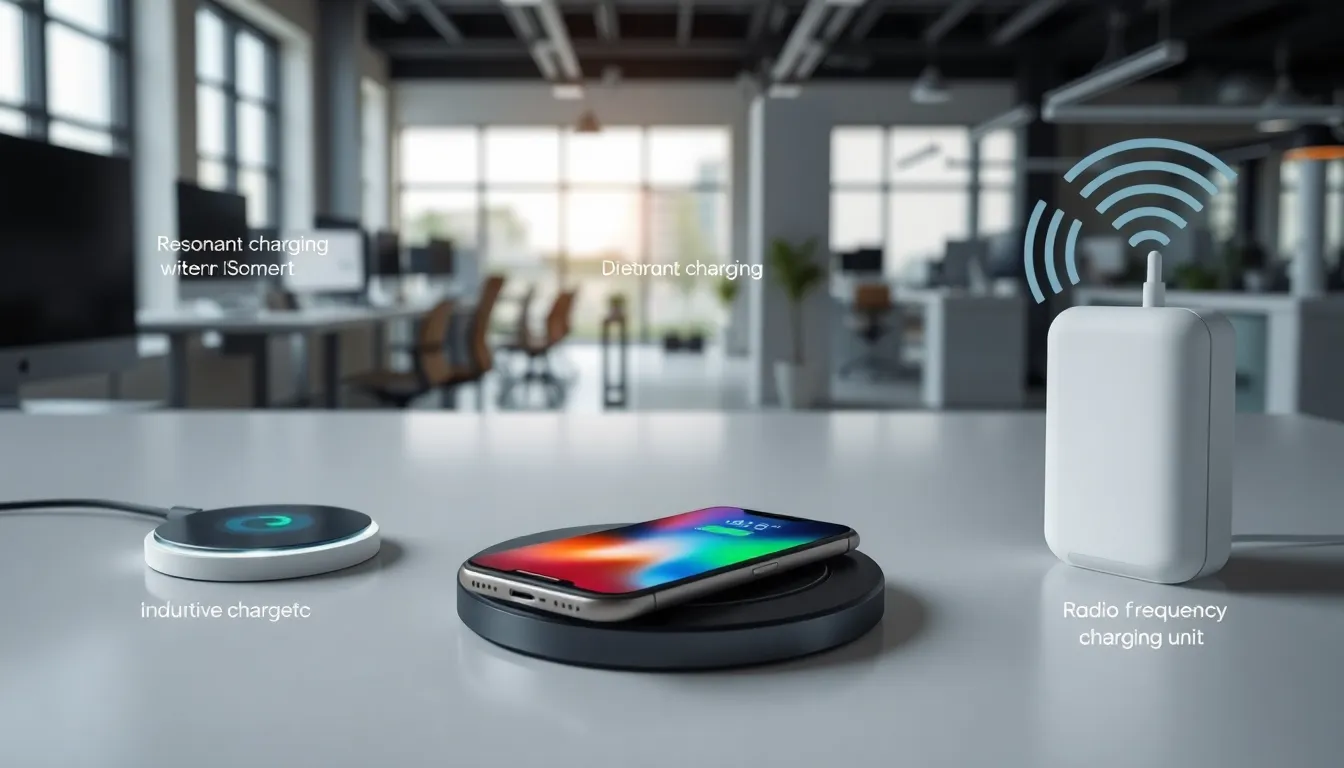
Wireless charging technology encompasses several methods for power transfer, each with distinct mechanisms and applications. Understanding these types clarifies their advantages and limitations.
Inductive Charging
Inductive charging represents the most widely adopted form of wireless charging. It employs electromagnetic fields to transfer energy between a charging pad and compatible devices. Key components include an inductive transmitter in the charger and a receiver in the device. The efficiency of inductive charging relies on precise alignment between these components, which typically operates at a distance of 0 to 4 centimeters. This method is commonly used for smartphones, wearables, and electric toothbrushes, with the Qi standard ensuring compatibility across various brands and devices.
Resonant Charging
Resonant charging expands upon inductive charging by allowing power transfer over greater distances, typically up to 10 centimeters. This method utilizes resonant inductive coupling, where both transmitter and receiver are tuned to the same resonant frequency, enhancing energy transfer efficiency. Resonant charging supports multiple devices simultaneously and provides more flexibility in terms of placement. Applications include electric vehicle charging systems and larger consumer electronics. Its potential for varied usage makes resonant charging a promising candidate for future wireless power solutions.
Radio Frequency Charging
Radio frequency (RF) charging utilizes electromagnetic waves to transmit energy over longer distances, sometimes reaching meters. This method captures energy from ambient RF sources or through dedicated transmitters, enabling devices to charge while in motion. RF charging suits IoT devices and sensors, where constant recharging isn’t feasible. Companies like Energous are advancing this technology, aiming to create a truly wire-free charging environment. The primary challenge remains efficiency; currently, RF charging faces limitations in power output and efficiency compared to other wireless charging technologies.
Advantages of Wireless Charging Technology
Wireless charging technology offers significant benefits, enhancing user experience and device longevity. Key advantages include convenience and ease of use, along with reduced wear and tear on devices.
Convenience and Ease of Use
Wireless charging eliminates the need for physical connectors. Users simply place their devices on compatible charging pads for power. This method reduces the hassle of connecting and disconnecting cables, especially in busy environments. Many wireless chargers feature multiple coils, allowing for flexible device positioning, which adds to user convenience. The technology is also increasingly found in public spaces, such as cafes and airports, making it easier to keep devices charged on the go.
Reduced Wear and Tear
Wireless charging minimizes physical connections, leading to less wear on charging ports. Frequent plugging and unplugging can damage connectors and ports, potentially requiring costly repairs. By using wireless charging, devices avoid such risks, promoting longer lifespans and improved durability. Additionally, wireless charging minimizes the risk of debris accumulation in ports, maintaining device performance over time.
Challenges in Wireless Charging Technology
Wireless charging technology faces several challenges that impact its overall effectiveness and user adoption. Key obstacles include efficiency issues and compatibility concerns.
Efficiency Issues
Efficiency in wireless charging remains a primary challenge. Compared to traditional wired chargers, wireless methods often experience energy loss during power transfer. Various studies indicate that inductive charging systems can have energy transfer efficiency ranging from 60% to 80%, while wired chargers typically exceed 90% efficiency. Energy loss can lead to longer charging times, potentially frustrating users who desire quick power boosts. Manufacturers are actively developing advanced technologies, including magnetic resonance and improved materials, to enhance efficiency and minimize energy waste.
Compatibility Concerns
Compatibility concerns hinder widespread adoption of wireless charging. Different manufacturers sometimes utilize varying charging standards, complicating cross-device charging. The Qi standard is the most widely accepted; however, devices that do not adhere to this standard may encounter charging difficulties. Instances of incompatibility increase with newer technologies and proprietary chargers. Users may invest in multiple chargers for different devices, leading to consumer confusion. Encouraging a unified standard across the industry could simplify user experiences and enhance the overall appeal of wireless charging technology.
Future Trends in Wireless Charging Technology
Emerging trends in wireless charging technology point towards increased efficiency and broader applications. Innovations and potential applications will define the next era of this transformative power delivery method.
Innovations on the Horizon
Innovations in wireless charging are set to enhance user experience and functionality. Improved efficiency through advancements in resonant charging can increase energy transfer rates, potentially exceeding current levels of 80%. Additionally, the development of multi-device charging pads allows simultaneous charging of several gadgets, reducing the clutter of multiple chargers. Companies are also exploring custom-designed charging solutions for specific gadgets, ranging from wearables to electric vehicles, promoting faster and more efficient charging. Furthermore, integration with smart home systems could allow devices to communicate and optimize charging times based on usage patterns.
Potential Applications
Potential applications for wireless charging technology expand beyond personal devices. Public infrastructure, like charging stations in parks and urban areas, can facilitate convenient power delivery for electric vehicles. Home automation systems may incorporate wireless charging capabilities for smart home devices, promoting cleaner and more efficient power management. In the healthcare sector, wireless charging can enhance the usability and longevity of medical devices, reducing the risk of wiring-related complications. Additionally, integration into furniture, such as desks and tables with built-in charging surfaces, can simplify device charging in everyday environments, fostering a seamless user experience.
Wireless charging technology is reshaping how people power their devices. Its convenience and ease of use make it an attractive option for modern lifestyles. As advancements continue to emerge, users can expect increased efficiency and broader compatibility across various devices.
The shift toward wireless solutions not only simplifies daily routines but also promotes longer device lifespans by reducing wear and tear. With the potential for integration into everyday environments and smart systems, wireless charging is set to become a staple in powering the future. Embracing this technology will undoubtedly enhance user experiences while paving the way for innovative applications across different sectors.


